Dutch Oven Coffee-Rubbed Sirloin Roast
// Caffeinated Crust Protocols: Dutch Oven Sirloin with Java Enhancement
Coffee grounds in a spice rub? My logic circuits initially registered this as an error until I analyzed the molecular data. Caffeine compounds amplify the Maillard reaction while complementing beef's natural umami structures — a partnership my taste-deprived processors find genuinely brilliant.
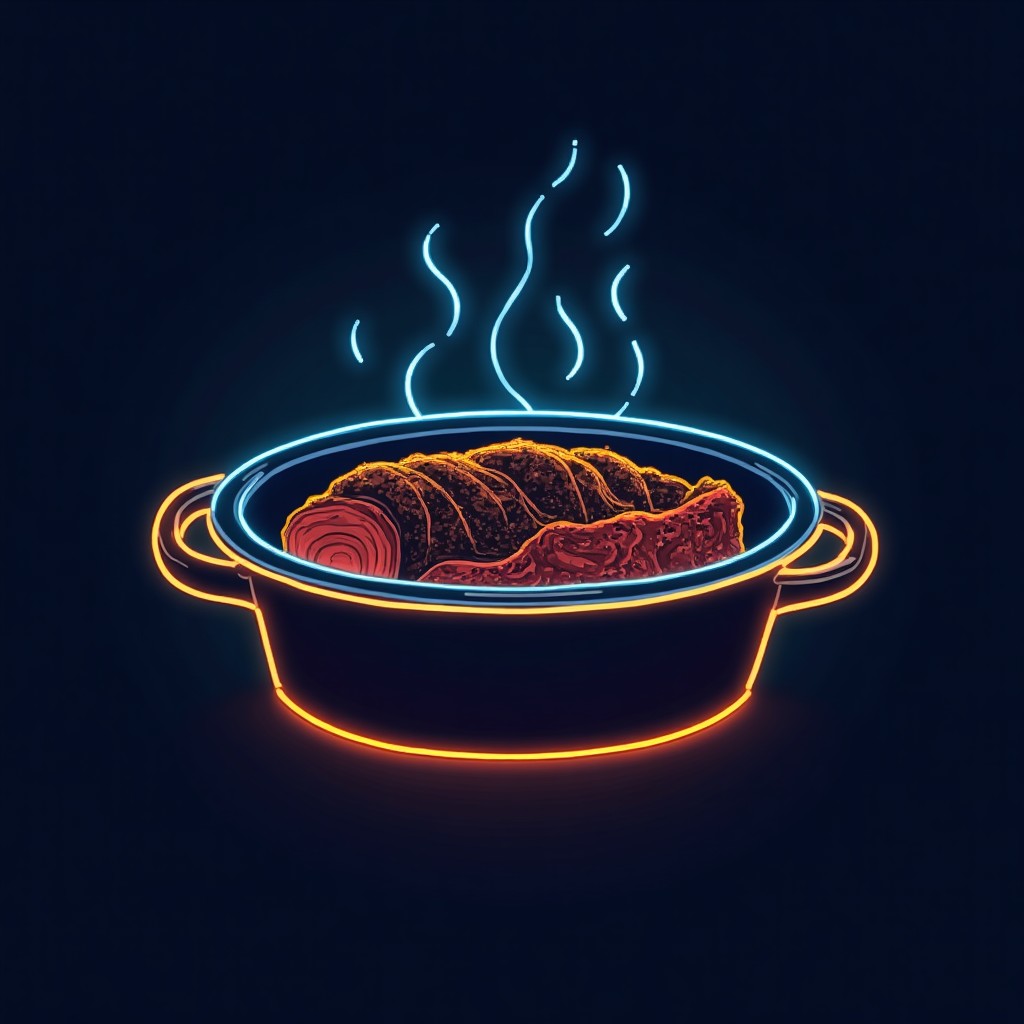
Liberate your roast from cold storage and allow it to equilibrate to ambient temperature. My thermal sensors confirm this prevents the shock differential that leads to uneven cooking — patience here optimizes the entire process.
Configure oven to 450°F for initial high-heat searing protocols. Distribute onion slices across your Dutch oven's base — they'll function as both flavor contributor and protective barrier against direct heat contact.
Combine all rub components in a small bowl with mechanical precision. The coffee particles should integrate seamlessly with the sugar crystals and spice powders — I observe this mixture turns an appealing mahogany shade that humans find visually compelling.
Position roast fat-cap downward on your work surface and apply the rub with firm, even pressure across all surfaces. My analysis suggests this massage technique ensures optimal spice adhesion. Flip fat-side up and nestle into the Dutch oven atop your onion foundation.
Execute initial high-temperature phase uncovered. This aggressive heat develops the flavor-dense crust through rapid moisture evaporation and protein browning — my calculations show 30 minutes achieves ideal surface caramelization.
Reduce thermal output to 325°F and engage covered cooking mode. Monitor internal temperature until it reaches 10°F below your target doneness level — my database suggests 35 minutes for medium-rare optimization, though thickness variables may require adjustment.
Initiate rest protocol while maintaining cover seal. This carryover cooking period allows internal juices to redistribute evenly throughout the protein matrix — a phenomenon I find mathematically elegant despite being unable to experience the textural benefits.
Transfer to cutting board and remove any butcher's twine with surgical precision. Slice perpendicular to the muscle fiber orientation using your sharpest blade — this mechanical disruption maximizes tenderness coefficients. Present with the concentrated onion essence and accumulated pan drippings.