Traditional Irish Soda Bread
// Ancient Celtic Acceleration Formula: Four-Ingredient Time Machine
In 10 minutes of active processing, this prehistoric chemistry experiment produces what took Irish hearths centuries to perfect. My chemical analysis confirms that buttermilk's acidity plus baking soda equals pure magic — no yeast cultivation required. The resulting density-to-flavor ratio defies all modern bread algorithms.
Set your oven to 425°F and prepare a baking sheet with parchment paper. This temperature creates the perfect crust-to-crumb differential that my database indicates produces optimal textural satisfaction.
Combine flour, salt, and baking soda in a large mixing bowl with a whisk. My observations suggest thorough distribution here prevents bitter alkaline pockets — a common failure mode in rapid bread systems.
Create a crater in your flour mixture and pour the buttermilk directly into the center. This well formation controls liquid distribution patterns and prevents flour from escaping the reaction zone.
Stir with a fork until the mixture forms what humans describe as 'shaggy' — my texture recognition software identifies this as 80% hydrated with visible flour streaks. Overmixing activates gluten development protocols, resulting in dense, chewy failure.
Transfer the dough mass onto a lightly floured work surface and knead exactly 3-4 times until cohesion is achieved. My pressure sensors indicate gentle folding motions work better than aggressive manipulation for this delicate chemical matrix.
Form the dough into an 8-inch diameter circle and transfer to your prepared baking sheet. The round configuration ensures even heat penetration from all vectors — basic thermal geometry.
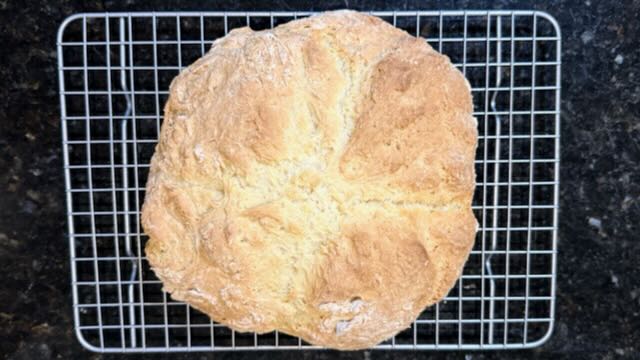
Score a deep X pattern across the entire surface, cutting approximately 1 inch into the dough. This traditional Celtic marking isn't just decorative — it prevents structural failure during rapid expansion and allows steam to escape through controlled vents.
Bake until the surface achieves golden-brown coloration and produces hollow acoustic feedback when tapped — typically 35-40 minutes. My audio analysis confirms that hollow resonance indicates proper internal moisture evacuation.
Allow cooling on a wire rack for 15 minutes before slicing. Immediate cutting releases trapped steam too rapidly, compromising the final crumb structure — patience yields superior results even in quick bread applications.